


Sleep Meditation Music: Your Natural Path to Deeper Rest
Table of Contents
How Sleep Meditation Music Transforms Your Nightly Routine
You know that feeling when you’re exhausted, but your brain just won’t shut off? You’ve tried everything—flipping your pillow, counting sheep, even that weird breathing trick your friend swore by. Nothing works. If this sounds familiar, Sleep Meditation Music might be exactly what you’ve been missing. It’s not just background noise or random relaxing tunes. This is specifically crafted audio that actually helps your brain shift into sleep mode.
Here’s the thing: while some people reach for solutions like Zopiclone tablets in Australia when sleep problems get serious, music offers something different. There’s no prescription needed, no morning hangover effect, and definitely no worrying about side effects. Real studies back this up—the right sounds can genuinely change how fast you fall asleep and how well you stay asleep. Let’s dig into why this works and how you can make it work for you.
What’s Actually Happening When You Listen?
Your brain is basically an electrical device. Seriously. It runs on waves of electrical activity that scientists can measure. When you’re wide awake, these waves are fast and choppy. When you’re sleeping deeply, they slow way down into these long, rolling patterns.
Sleep meditation music works because it contains frequencies that match those slow sleep waves. Your brain hears them and starts copying that pattern. It’s called entrainment, and it’s the same reason you start nodding your head to a good beat without thinking about it.
The music hits two main frequency zones:
Delta territory (super low, 0.5-4 Hz): This is where your brain lives during the deepest sleep stages. When the music mimics this, your brain follows along.
Theta range (4-8 Hz): Ever catch yourself in that dreamy state where you’re not quite asleep but not really awake? That’s theta. The music guides you there first, then down into the delta.
Beyond brainwaves, something else happens in your body. Your nervous system has two modes—fight-or-flight and rest-and-digest. Guess which one keeps you awake at midnight, stressing about tomorrow’s meeting? The music flips that switch, telling your body it’s safe to power down.
What Makes Some Sleep Music Actually Work
Not every “relaxing” playlist will knock you out. The good stuff has specific ingredients:
Speed Matters More Than You Think
Effective sleep tracks sit around 60-80 beats per minute. Why? Because that matches your resting heartbeat. Your cardiovascular system literally syncs up with what you’re hearing. Play something at 120 BPM, and you’re basically asking your heart to speed up. Not exactly sleep-inducing.
The beat also needs to be predictable. Random tempo changes jolt your attention, which is the opposite of what we’re going for.
Keep the Melody Simple
Your brain shouldn’t have to work when you’re trying to sleep. Complex compositions with lots of instruments, key changes, and unexpected notes? That’s engagement. That’s your brain saying, “Ooh, what’s happening next?”
Sleep music uses repetition. The same gentle phrase loops with subtle variations. Minor keys tend to feel more soothing than bright major ones. It’s boring by design—and that’s exactly the point.
Instrument Selection
Certain sounds just hit different. Piano and strings dominate sleep music because they produce smooth, sustained tones. A jarring electric guitar or punchy brass section would wake you up, not lull you down.
Nature sounds layer in beautifully—rainfall, ocean waves, wind through trees. These aren’t just pretty; they’re what’s called “pink noise,” which has proven sleep benefits.
The Stuff Nobody Tells You About the Benefits
Sure, you’ll sleep better. But that’s just the start.
Your stress levels drop across the board: Listen regularly, and your baseline stress hormones actually decrease. You become calmer during the day, not just at night.
Focus gets sharper: Lots of people use their sleep trackers during work or study sessions. Your brain learns to associate those sounds with a calm, concentrated state.
Pain bothers you less: This one surprised me, too, but research from the National Center for Complementary and Integrative Health shows relaxing music can legitimately reduce how much pain you feel. Your brain gets distracted, and your body releases natural painkillers.
Anxiety backs off: When your thoughts are spiraling, the predictable nature of sleep music gives your mind something steady to grab onto.
Getting It Right: The Practical Stuff
Just hitting play won’t cut it. Here’s how to actually use this:
Build the Habit
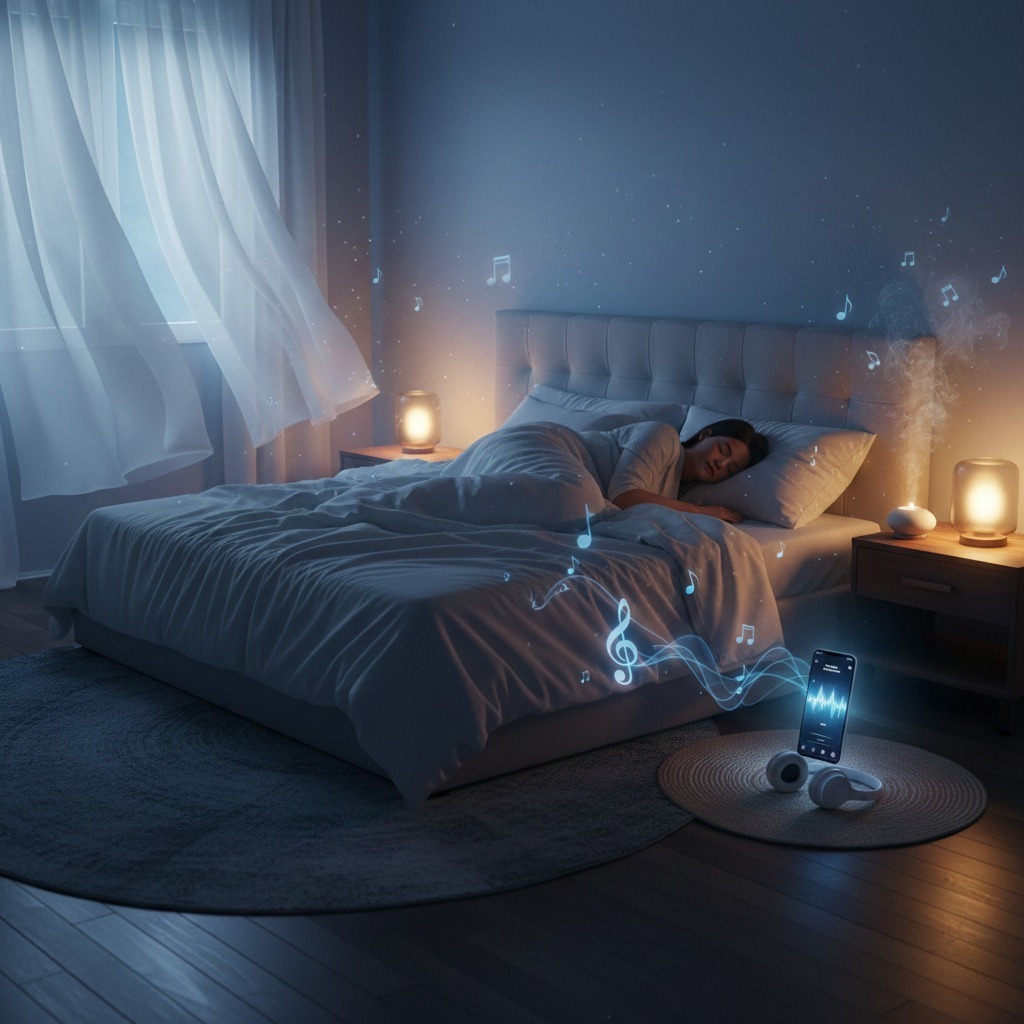
Start your playlist 30-45 minutes before bed. Not when your head hits the pillow—before. This gives your system time to respond. Use the same playlist every night. After a couple of weeks, your brain starts recognizing the opening notes as a sleep cue.
Set Up Your Space Properly
Volume is crucial. If you’re actively listening to the music, it’s too loud. You should barely notice it’s there—more of a presence than a performance. Most streaming apps have sleep timers. Use them. You don’t need music playing at 4 AM during your lighter sleep cycles.
Stack Your Habits
Music works way better when paired with other smart sleep moves. Dim your lights an hour before bed. Keep your room cool—like, 65-68 degrees cool. And for the love of everything, put your phone down. The music can’t fight a bright screen blasting blue light at your face.
Try Different Flavors
Some people love pure instrumentals. Others swear by binaural beats or those “8 hours of thunderstorms” videos. You need to experiment. What relaxes your nervous system might not work for someone else. Give each style at least a week before deciding.
Don’t Do These Things
Even with great music, people mess this up:
Picking the wrong tracks: If it’s got lyrics, it’s wrong. If it makes you want to dance, it’s wrong. Your brain processes words and rhythm, which activates rather than relaxes.
Blasting the volume: This isn’t a concert. Background levels only.
Giving up too fast: Most people need at least a week of consistent use before seeing real changes. Your nervous system isn’t a light switch.
Using it randomly: Tuesday night only, or just when you’re desperate? That won’t build the association your brain needs.
When Music Isn’t Enough
Look, sometimes sleep issues run deeper. If you’ve been struggling for months, that’s worth talking to a doctor about. Options like Zopiclone tablets in Australia exist for severe cases, though they come with real risks—dependency, side effects, and tolerance issues.
Before going pharmaceutical, try these alongside your music:
CBT-I (therapy specifically for insomnia): This actually retrains how you think about and approach sleep. It’s incredibly effective.
Progressive muscle relaxation: You tense and release each muscle group systematically. Sounds weird, works great.
Guided meditations: Someone talks you through relaxation while music plays underneath.
Noise machines: Consistent white or pink noise can mask disruptive sounds if you live somewhere loud.
Frequently Asked Questions
Q1: How long should I listen to sleep meditation music before bed?
Give yourself 30-45 minutes of music time before you actually want to be asleep. Your body needs that runway to wind down.
Q2: Can I use sleep meditation music every night?
Absolutely. Daily use is completely fine and actually makes it work better over time.
Q3: Will I become dependent on the music to sleep?
Nope. This is behavioral conditioning, not chemical dependency. You can stop whenever without any withdrawal or problems.
Q4: What’s the ideal volume for sleep music?
Barely there. Think of it as sonic wallpaper—present but not demanding attention.
Q5: Do I need special headphones or speakers?
Regular speakers work perfectly. If you prefer headphones, get ones designed for sleeping so they don’t hurt your ears.
Q6: How is this different from regular relaxing music?
Sleep-specific music uses exact tempos, frequencies, and structures based on sleep science. Random chill music might be relaxing, but it won’t necessarily trigger sleep.
Q7: Can children use sleep meditation music?
Yes, it’s completely safe for kids and often helps establish healthy sleep patterns early.
Q8: What if the music doesn’t work after two weeks?
Switch up your style or layer in other techniques. If problems continue beyond that, talk to a sleep specialist about what else might be going on.
The Real Long Game Here
Here’s the truth about Sleep Meditation Music: it’s not magic, and it won’t fix everything overnight. But stick with it, and the changes add up. You’ll notice you’re falling asleep faster—maybe shaving 15-20 minutes off that anxious waiting period. You’ll wake up less during the night. Mornings feel different when you’ve actually rested.
Those benefits compound. Better sleep means better mood, clearer thinking, a stronger immune system, and more energy. Suddenly, you’re more patient with your kids, more productive at work, and more present with friends.
The best part? That pre-bed routine stops feeling like a chore and starts feeling like something you look forward to. Instead of dreading bedtime because you know you’ll just lie there stressing, you’ve got this peaceful ritual that signals to your whole system: it’s time to rest.

Author: Darwin
Darwin has spent the better part of a decade writing about sleep problems and the medications used to treat them. Based in Melbourne, he’s become something of a specialist in explaining pharmaceutical information to ordinary Australians who just want a decent night’s rest…Read more